How to Build a Car Rental Marketplace Like Turo (MVP in 3–6 Weeks)
Build a Turo clone on WordPress or Laravel: how peer-to-peer car sharing works, the features an MVP needs, insurance realities, native apps, and a $5–10k launch path.
Turo turned every idle car into rentable inventory. Owners list the car they already own, travellers book it by the day, and the platform takes a cut of every trip while handling payments, verification and protection. It’s an asset-light business — you never buy a single vehicle — and that’s exactly why founders keep asking how to build one.
The good news: you don’t need a year and a seven-figure budget. A focused car-sharing MVP on WordPress or Laravel can realistically ship in 3–6 weeks for roughly $5,000–$10,000. Here’s how the model works, what your first version actually needs, and where the money and time go.
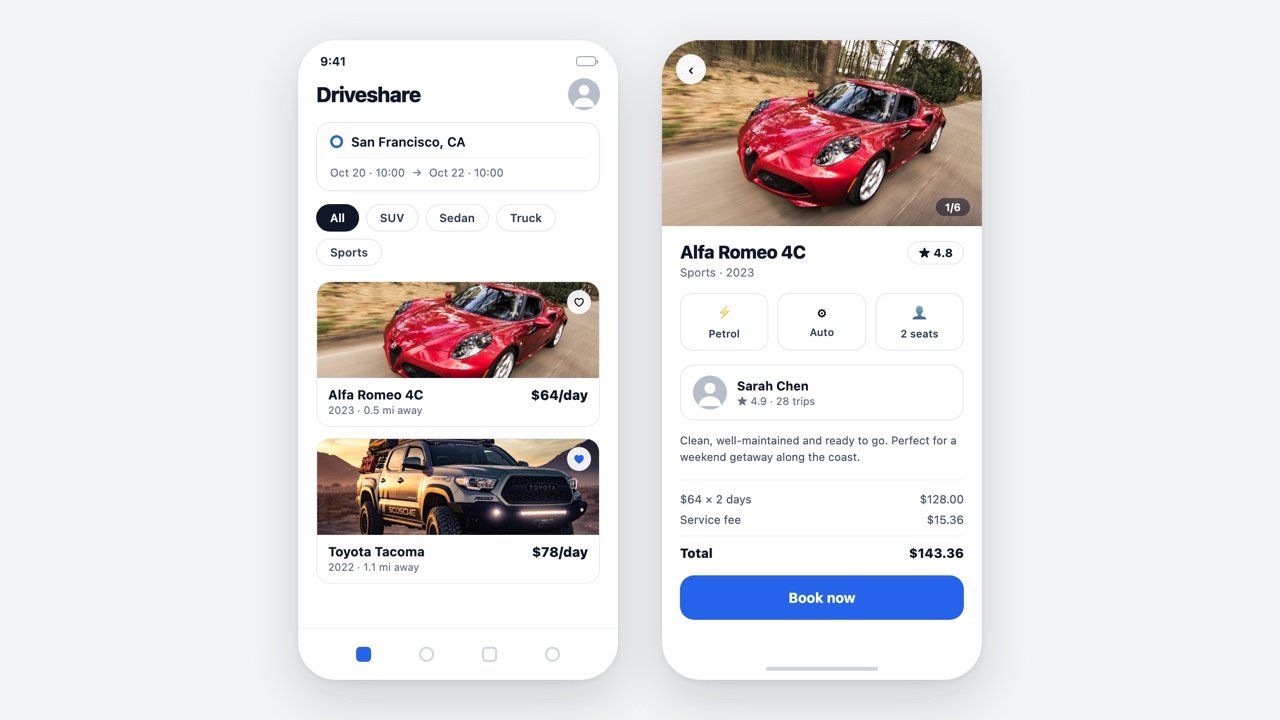
The mockup above shows the two screens that carry the whole product: a search screen where guests filter cars by location and dates, and a booking screen with specs, host profile and a transparent price breakdown. Get those two right and you have a car-sharing app.
How Turo Actually Works
Turo is peer-to-peer car sharing, not a rental agency. The mechanics:
- A host lists a car — photos, description, location, daily price, and an availability calendar for the dates it’s free.
- A guest searches and books — by city or airport, dates, vehicle type, price and features. Booking is instant or host-approved.
- The platform verifies the guest — identity and driving-licence checks are what make strangers comfortable handing over car keys.
- Money flows through the platform — the guest pays up front, the platform holds funds, takes its commission, and pays the host out after the trip.
- Check-in and check-out with photos — timestamped photos at pickup and return are the evidence trail for any damage claim.
- Both sides review each other — ratings are the trust layer that makes the whole thing work.
Revenue is usually dual-sided: a commission from the host plus a service or trip fee from the guest. Many platforms also tier that commission by protection plan — hosts who take more risk keep more of the trip price.
What Your MVP Actually Needs
Resist the urge to clone every Turo feature. A credible first version needs exactly this:
- Vehicle listings with photos, specs, location, daily/weekly pricing and an availability calendar
- Search and filtering by location, dates, vehicle type, price and features
- Booking and checkout with a real payment flow, deposits, and cancellation rules
- Identity and driving-licence verification — non-negotiable for trust and for your insurer
- In-app messaging between host and guest, so conversations stay on your platform
- Trip management with photo check-in/check-out, mileage and fuel notes
- Host earnings dashboard with payout tracking and a statement per trip
- Reviews and ratings on both sides
- Admin controls — commission configuration, dispute handling, and basic analytics
- A mobile experience that doesn’t fight you — a large share of bookings happen on a phone, often at the kerb
Everything else — dynamic pricing, keyless entry hardware, fleet tools for hosts with ten cars, loyalty programmes — belongs in version two, after real users tell you what they’re missing.

WordPress or Laravel? Pick by Ambition, Not Fashion
Both are legitimate answers, and the choice mostly comes down to how far you intend to take this.
WordPress is the affordable route. You inherit user accounts and roles, a listings engine, media handling, payment gateway integrations, reviews and a huge plugin ecosystem — so you’re customising a marketplace instead of inventing one. That’s the difference between launching this quarter and launching next year. It’s the right call for a regional launch, a niche play, or any founder who wants to validate demand before committing serious capital. See our best WordPress marketplace themes roundup for the general landscape.
Laravel is the more robust route. You get a clean API-first backend, which matters if native mobile apps are central to your product, if you expect heavy booking volume, or if your business logic diverges sharply from the standard rental flow. It costs more up front and buys you more headroom.
A practical middle path is common: WordPress for the marketplace website, a Laravel API layer feeding native iOS and Android apps. Whatever you pick, you own the code and the customer relationships — no SaaS platform taking a slice on top of your own commission.
| WordPress | Laravel | |
|---|---|---|
| Up-front cost | Lower | Higher |
| Time to launch | Fastest | Longer |
| Best for | Regional or niche launch, validating demand | App-first products, heavy volume, unusual logic |
| You inherit | Accounts, listings, media, payments, reviews | A clean API-first foundation and nothing else |
| Trade-off | Working within a theme’s assumptions | Building more of it yourself |
Choose WordPress if you want to be live this quarter and learn from real bookings. Choose Laravel if you already know the apps are the product and you’re funded to build properly.
The Honest Part: Insurance and Liability
This is the section most “how to build a Turo clone” articles skip, and it’s the one that decides whether your platform survives.
Turo’s real moat isn’t its software — it’s the protection programme sitting behind every trip. Someone else’s car is being driven by a stranger, and when it gets damaged, somebody pays. Five questions you need answers to before launch:
- Who insures the vehicle during a trip — the host’s personal policy almost certainly excludes commercial use, so something has to fill that gap
- What the host’s deductible is, and which protection tier they chose
- How a claim is filed, who assesses it, and how fast the host gets paid
- What your platform’s legal exposure is in your specific jurisdiction
- What happens in the ugly cases — theft, an uninsured third party, a guest who disappears
In most markets the answers involve a commercial partnership with an insurer or broker, plus terms of service written by an actual lawyer.
The software side is the easy half: photo check-in/check-out, a claims and incident reporting workflow, and document collection. The commercial side is the hard part, it’s worth solving before you write a line of code, and it should be budgeted separately from your build.
The Fastest Route: a Ready-Made Turo Clone
Assembling listings, calendars, verification, split payments and a claims workflow from generic plugins is possible, but availability calendars, deposit handling and payout splits are precisely the pieces generic tools handle worst. A purpose-built solution saves months here.
SiteMile — a top pick in our WordPress agencies roundup for ready-made platform builds — offers a Turo clone built specifically for the car-sharing model. It runs on WordPress for affordable builds or PHP Laravel for more robust ones, and the package includes the marketplace website plus native iOS and Android apps, with full source code handed over. The feature set covers the MVP list above: listings with calendars and pricing controls, search and filtering, identity and licence verification, bookings with secure payments, host–guest messaging, photo check-ins, host earnings dashboards, claims workflows, and admin commission configuration. Optional extras include keyless-entry hardware integration and dynamic pricing.
At the time of writing:
- Starter package: from $5,500 — website plus native iOS and Android apps, full source code handed over
- Realistic MVP budget: $5,000–$10,000 for a focused first launch
- Timeline: roughly 3–6 weeks for that MVP, plus app-store review on the mobile side; wider scopes stretch toward 12 weeks
- Complex builds: up to $50,000 — worth knowing about, not worth paying for until the model is proven
- Compare against: six-plus months and a five- or six-figure bill for a from-scratch build
You don’t need the top of that range to find out whether your market wants this. If your model diverges from the standard flow, our own WordPress development services can extend or tailor a platform to your exact requirements.
Payments: Deposits, Splits and Payouts
Car sharing has a nastier payment profile than most marketplaces. A single booking can involve five separate money movements:
- The up-front charge when the guest books
- A refundable security hold authorised against the guest’s card
- Your commission, deducted at source
- The host payout, released after the trip completes
- A damage charge, occasionally, days after the car came back

You’ll want a gateway with marketplace or split-payment support (Stripe Connect is the usual answer) so payouts route to hosts automatically and your commission is deducted at the source. Card authorisations for deposits, and a clear refund policy for cancellations, matter just as much. Our guide to WooCommerce payment gateways covers the options and the trade-offs.
A Realistic Launch Plan
- Pick a narrow market. “Turo but everywhere” loses. “Car sharing at Faro airport” or “EV-only sharing in Austin” is winnable — and dense supply in one city beats thin supply in twenty.
- Sort insurance and terms first. No protection story, no platform.
- Choose your stack — WordPress for speed and cost, Laravel if apps and scale are central.
- Set up solid WordPress hosting — booking traffic and image-heavy listings punish cheap shared plans.
- Configure listings, calendars, verification and payouts, then run the full flow end to end with real test bookings, including a cancellation and a damage claim.
- Recruit hosts before guests. An empty marketplace converts nobody. Ten well-photographed cars in one city beats a hundred scattered listings.
- Launch, collect reviews, iterate. Early trust compounds faster than early revenue.
For a closely related model with the same trust-and-escrow spine, see our guide to building a shipping marketplace like uShip.
FAQ
Can you really build a Turo clone on WordPress?
Yes. WordPress already provides accounts, listings, media, payments and reviews, and purpose-built car-sharing solutions add the calendars, verification, bookings and payout splits on top. For heavier builds — especially API-driven native apps — Laravel is the stronger backend, and some builds combine the two.
How much does it cost to build a car rental marketplace?
A ready-made starter package begins around $5,500 at the time of writing, putting a realistic MVP in the $5,000–$10,000 range including native mobile apps. Complex custom implementations run up to $50,000, and a fully bespoke from-scratch build costs far more. Our auction website cost guide gives a comparable breakdown for a related marketplace model.
How long does it take to launch?
Plan for 3–6 weeks for a focused MVP, with app-store review adding time on the mobile side. Wider scopes stretch to around 12 weeks. A from-scratch build is typically six months or more.
Do I need native mobile apps?
Not to validate the idea — but sooner than you’d like. Guests book on their phones, often at the kerb, and hosts manage trips from theirs. Photo check-in/check-out is dramatically better in an app than in a mobile browser, so budget for apps as part of the plan rather than a later surprise.
How does a car sharing platform make money?
Most take a commission from the host plus a service fee from the guest, with the commission rate tied to which protection tier the host chooses. Additional revenue comes from delivery fees, insurance upsells, extra-mileage charges and featured listing placements.
What’s the hardest part?
Not the software — the insurance and liability model, and getting enough cars listed in one city to make search results look worth browsing. Solve those two and the technology is the straightforward half of the problem.